Scream!: The Rise, Fall, and Afterlife of Britain’s Horror Comic
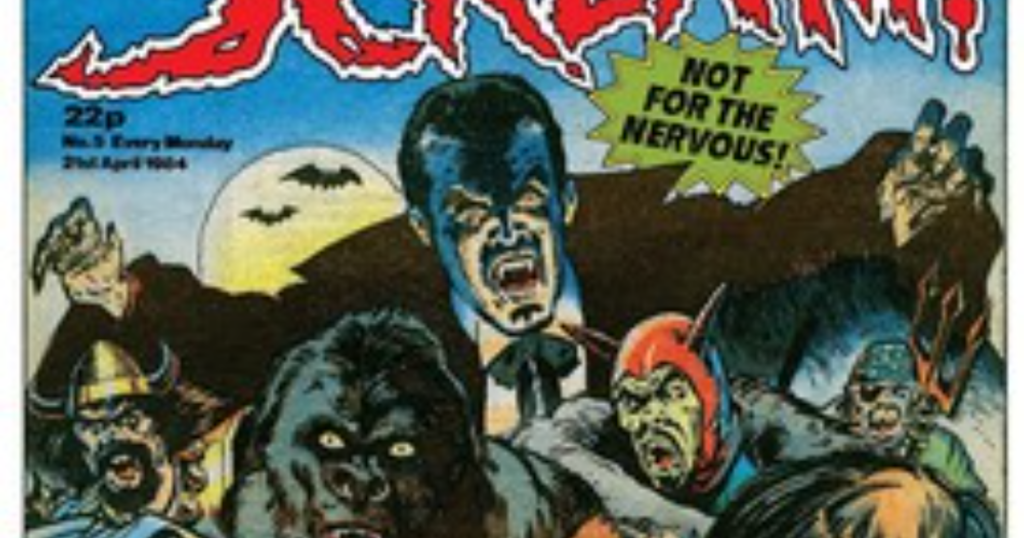
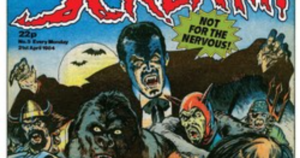
When Scream! appeared on British newsstands in March 1984, it looked like a dare. It was loud, ugly in the best possible way, and openly thrilled by the idea of being too much for polite company. Published by IPC Magazines, Scream! was a weekly anthology comic aimed at children and teenagers, but it drew its energy from horror cinema, pulp shockers, and the anarchic tradition of British comics. Its life was brief – only 15 issues under its own title – yet its reputation has lasted for decades. That is unusual even in the crowded history of UK comics, where many weeklies vanished quickly and left little trace. Scream! survived in memory because it arrived at exactly the right moment: when British comics were experimenting wildly, when moral anxiety about children’s entertainment still had real force, and when horror was both commercially attractive and culturally suspect.
The World That Produced Scream!
To understand Scream!, it helps to understand the British weekly comic market that shaped it. For much of the twentieth century, British children’s comics were sold as inexpensive anthologies, usually published every week, packed with short serial episodes, gag strips, text features, letters pages, and lurid covers designed to seize attention at the newsagent. Unlike the American superhero model, where one or two headlining characters often dominated a title, British comics typically offered a menu: war stories, school stories, science fiction, humour, sport, and adventure all rubbing shoulders in the same issue.
By the late 1970s and early 1980s, that market was changing. Television competed harder for children’s attention, readership was fragmenting, and publishers were constantly launching new titles in the hope that one would catch fire. IPC, one of the major players, had already shown with 2000 AD that there was an audience for bolder, more aggressive material. That comic’s success proved that young readers would embrace antiheroes, dystopian violence, satire, and a visual style far harsher than the gentler adventure strips of earlier decades. Horror was a natural next step.
There was also a broader cultural context. Britain in the early 1980’s was in the grip of recurring arguments about media effects: “video nasties,” tabloid campaigns against permissiveness, and a familiar adult suspicion that popular culture was becoming too graphic, too cynical, and too available to the young. A children’s horror comic did not just have to succeed artistically. It had to survive socially.
Launching a Comic Designed to Unsettle
IPC launched Scream! on 24 March 1984. From the start, the comic’s identity was unusually coherent. It was not simply a general boys’ adventure paper with one spooky strip added for variety. Horror was the brand. The title itself, punctuated with an exclamation mark, advertised a shriek rather than a story. The covers often emphasized decay, menace, distorted faces, claws, slime, or some grotesque visual hook. Even the editorial voice leaned into mock-horror showmanship.
The comic’s format remained recognizably British: short episodic strips, cliffhangers every few pages, recurring serials, and a tone that mixed dread with gleeful sensationalism. But Scream! felt more concentrated than many of its rivals. Its stories were often about revenge, monsters, curses, body horror, death traps, and moral corruption. Adults in these stories could be weak, cruel, blind, or actively dangerous. The world was unstable, and punishment was often spectacular.
That intensity was part of the appeal. Readers were being offered the thrill of transgression inside a familiar weekly package. Scream! promised that this was the comic your parents might disapprove of – which, for its audience, was practically part of the sales pitch.
The Comic Strips That Built Its Reputation
Though Scream! contained several notable features, a few strips came to define its legacy.
Monster
The best-known by far is Monster, written by Alan Moore and drawn by Heinzl. It reimagined the Frankenstein myth through the eyes of the creature itself, presented not merely as a brute but as a tragic, hunted being wandering through a hostile world. In many histories of the comic, Monster is treated as the jewel in the crown, and with good reason. It carried emotional depth unusual even in a strong anthology field. Its violence mattered because it was tied to pain, alienation, and persecution. The strip also now attracts attention because of Moore’s later fame, but it would still stand out without that connection.
The Thirteenth Floor
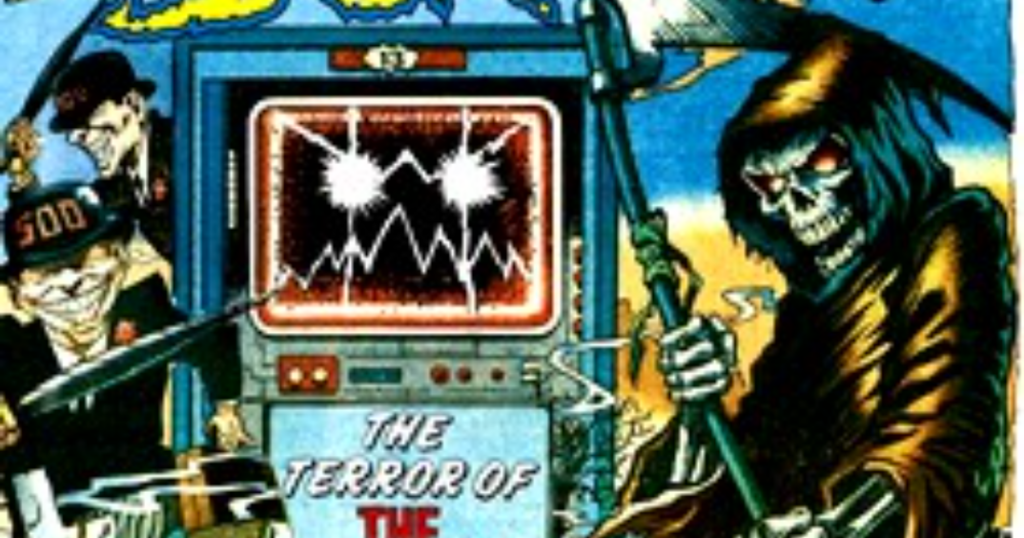
Almost as famous is The Thirteenth Floor, centered on Max, a sinister computer controlling a tower block and inflicting psychological punishments through a virtual-reality simulation known as “the Thirteenth Floor.” The premise captured an early-1980s technological anxiety brilliantly. Max was not a shambling monster from the past but an inhuman intelligence embedded in modern life, calmly judging human wrongdoing. The strip’s coldness made it memorable. Its horror was less gothic than clinical.
Return of the Sentinels
Return of the Sentinels supplied a different flavour: giant stone figures awakened to pursue vengeance. Like many effective British horror strips, it turned a simple image into an inexorable threat. The power came from repetition and inevitability – readers knew that once the Sentinels were moving, someone would pay.
Library of Death and Other Shock Strips
The comic also included shorter-format material such as Library of Death, hosted by a macabre librarian figure who introduced compact tales of doom. These anthology shockers linked Scream! to older horror traditions: the host-led morality tale, the twist ending, the grim joke at human weakness’s expense. There were other strips too, including bizarre and often nasty serials that deepened the title’s atmosphere of relentless menace.
What united these features was not just “horror” in the abstract, but a specific editorial instinct. Scream! was good at finding concepts that could be explained in one sharp sentence – a haunted child, a vengeful creature, a murderous system, a cursed artifact – and then stretching that idea through weekly suspense.
Style, Tone, and the British Horror Comic Tradition
One reason Scream! remains interesting is that it did not simply imitate American horror comics. It belonged to a distinct British line of storytelling. Its pacing was clipped and cliffhanger-heavy. Its pages were built for weekly consumption, which meant every installment needed one striking image, one escalation, or one final beat strong enough to pull the reader into the next issue.
Artistically, the comic drew heavily on high-contrast, expressive illustration. Faces twisted. Settings rotted. Machines looked predatory. Ordinary spaces – tower blocks, schools, laboratories, streets – became oppressive. British horror comics often worked best when they invaded the mundane rather than escaping into fantasy worlds, and Scream! understood that well. A lot of its menace came from seeing familiar environments become malicious.
Its tone also mattered. Scream! could be frightening, but it was rarely solemn for long. There was a certain grinning nastiness to it, a sense that the comic enjoyed the theatricality of horror. This is part of what made it feel dangerous while keeping it entertaining. It was shocking, but not joyless.
Why it Caused Controversy
The same qualities that made Scream! distinctive also made it vulnerable. British moral panics of the period created a climate in which a children’s horror comic could become an easy target. Concerns were raised about the suitability of the content for younger readers, and the title reportedly attracted criticism from campaigners and from within distribution channels concerned about public reaction.
The issue was not simply gore, though the comic certainly pushed visual menace harder than many contemporaries. The deeper problem was branding. A horror comic sold directly to children and marketed with such unapologetic intensity was easier to single out than a mixed-genre paper. If a parent objected to one war strip in an adventure anthology, that was one thing. If the entire publication announced itself as a nightmare machine, the objection became simpler and more symbolic.
This is one of the paradoxes of Scream!: it was not the most extreme horror material available in 1980s Britain by any means, but because it sat in a mainstream children’s comics format, it became highly visible. It was transgressive in the wrong place.
The Abrupt End
After only 15 issues, IPC cancelled Scream! as a standalone title in June 1984. In the normal British comics business, a failed weekly was often not simply killed outright but merged into another publication. That is what happened here: Scream! was absorbed into Eagle. Some of its strips survived the transition, at least for a time, continuing under the merged banner.
This kind of merger was common industrial practice, but in the case of Scream! it contributed strongly to the comic’s legend. Because its run was short, it came to seem forbidden, interrupted, almost mythic – a title that had been cut down just as it was finding its voice. Long-running comics are remembered through volume. Scream! was remembered through scarcity.
Its cancellation also says something about the economics of British weeklies. However inventive a comic might be, survival depended on enough sales, enough retailer confidence, and enough institutional patience to weather public criticism. A comic could be good, admired, and influential without being commercially secure. Scream! became one of the clearest examples.
Life After Cancellation
The afterlife of Scream! has been almost more important than its original publication. Several of its strips continued to circulate in reprints, annuals, collected editions, and fan memory. Over time, Monster and The Thirteenth Floor especially came to be treated as classics of British comics horror. The involvement of creators who later gained wider prestige also encouraged retrospective interest.
As comics scholarship and fandom became more attentive to overlooked British material, Scream! benefited from reevaluation. Instead of being remembered merely as a failed or controversial weekly, it was increasingly seen as an artifact of a particularly inventive editorial culture. Historians and fans began to value it for how efficiently it captured an era’s sensibility: punkish, commercial, opportunistic, funny, nasty, and formally sharp.
Reprints helped new readers see that the comic was more than a curiosity. Much discussion of vanished comics rests on nostalgia alone, but Scream! has endured partly because the work still reads well. The pacing remains effective. The concepts are strong. The atmosphere survives.
Alan Moore and the Pull of Retrospective Prestige
Any history of Scream! now has to reckon with Alan Moore’s presence. Because Moore later became one of the most celebrated writers in modern comics, his contribution to Monster draws inevitable attention. That can distort the picture slightly if readers begin to treat Scream! merely as an early footnote in the career of a future star. In reality, the comic was a collaborative anthology with strengths well beyond a single name.
Still, Moore’s presence matters. It reminds us that the British comics weeklies of the period were training grounds where major talent learned to work fast, serialize effectively, and hook readers under intense space constraints. Scream! was part of that ecosystem. It shows how much craft could emerge inside ostensibly disposable popular culture.
Scream! and the Wider History of British Comics
The comic also deserves a place in the larger story of British comics because it reveals the flexibility of the anthology form. British weeklies could absorb almost any genre – science fiction, sport, war, humour, mystery, horror – and rebuild it according to the demands of cliffhanger serialization. Scream! was a vivid demonstration of that adaptability.
It also highlights the instability of the market. British comics history is full of launches, cancellations, mergers, and reinventions. That volatility could be brutal, but it also created spaces for experimentation. Publishers were willing to try strange ideas because the system was already accustomed to rapid turnover. Scream! existed because editors believed a horror weekly might seize the moment. Its cancellation shows the risk of that gamble; its legacy shows the value of taking it.
There is another reason it matters. Scream! sits at the intersection of children’s culture and horror, forcing us to question neat assumptions about what young readers wanted or could handle. British children’s media has often been rougher, darker, and more morally abrasive than outsiders expect. Scream! did not emerge from nowhere. It exaggerated tendencies already present in British storytelling: grotesque humour, cruelty as comedy, and the pleasure of scaring the audience just enough to keep them coming back next week.
Why Scream! Still Matters
Today, Scream! is remembered not because it dominated the market, but because it burned brightly and disappeared fast. Its short life concentrated its meaning. It represents the end of an era when weekly British comics could still launch with swagger and gamble on a strong editorial identity. It captures a moment when horror, technology anxiety, moral panic, and kids’ entertainment collided in a particularly British form.
Most of all, it endures because the comic had character. It knew exactly what it was trying to do. It wanted to horrify, to tease, to disgust, to provoke, and to entertain. For 15 issues, it did so with remarkable confidence. The fact that it was shut down so quickly only sharpened its image. In comics history, obscurity often erases. In the case of Scream!, brevity became part of the legend.
The result is a title that still fascinates readers, historians, and creators: a minor classic, a cultural flashpoint, and one of the most memorable ghosts in British comics history.